Lung Supplement vs Air Purifier: Which Is Worth It?
| Air purifier | A device that cleans the air before you breathe it — filtering dust, pollen, smoke and other particles from a room. |
| Lung supplement | A daily botanical capsule taken internally for everyday support of your airways from the inside. |
| Best pick | Not either/or. Improve the air first, then add a supplement as a support layer — both work at different points in the same system. |
The phrase lung supplement vs air purifier sets up a contest that does not really exist, because the two do fundamentally different jobs at different points in the same chain. An air purifier changes the air going in; a lung supplement supports the body receiving it. Framing them as rivals is a bit like asking whether a water filter is better than drinking water — they are not competing, they are complementary. This guide explains what each one actually does, where they overlap, what they cost, and how to decide where your money and effort are best spent.
As always, a ground rule first: neither an air purifier nor a dietary supplement is a treatment for a lung condition, and nothing here is medical advice. If you have asthma, COPD, a persistent cough or any diagnosed respiratory issue, a healthcare professional is your first stop; read this as everyday-wellness background.
What an air purifier actually does
An air purifier is a device that pulls the air in a room through one or more filters — commonly a HEPA filter for fine particles and sometimes an activated-carbon filter for odours and gases — and returns cleaner air to the room. Its job is prevention at the source: by capturing dust, pollen, pet dander, smoke particles and other airborne matter, it reduces what you breathe in the first place. For anyone living with poor indoor air quality — near traffic, in a smoky or dusty environment, or during high-pollen or wildfire-smoke periods — that is a genuinely valuable, tangible intervention.
Its limits are equally clear. An air purifier only cleans the air in the space it serves; step outside its range and it does nothing. It has an upfront cost plus ongoing filter replacements and electricity. And crucially, it does nothing inside your body — it cannot supply antioxidants, soothing herbs or any nutritional support. It is an environmental tool, full stop.
What a lung supplement offers instead
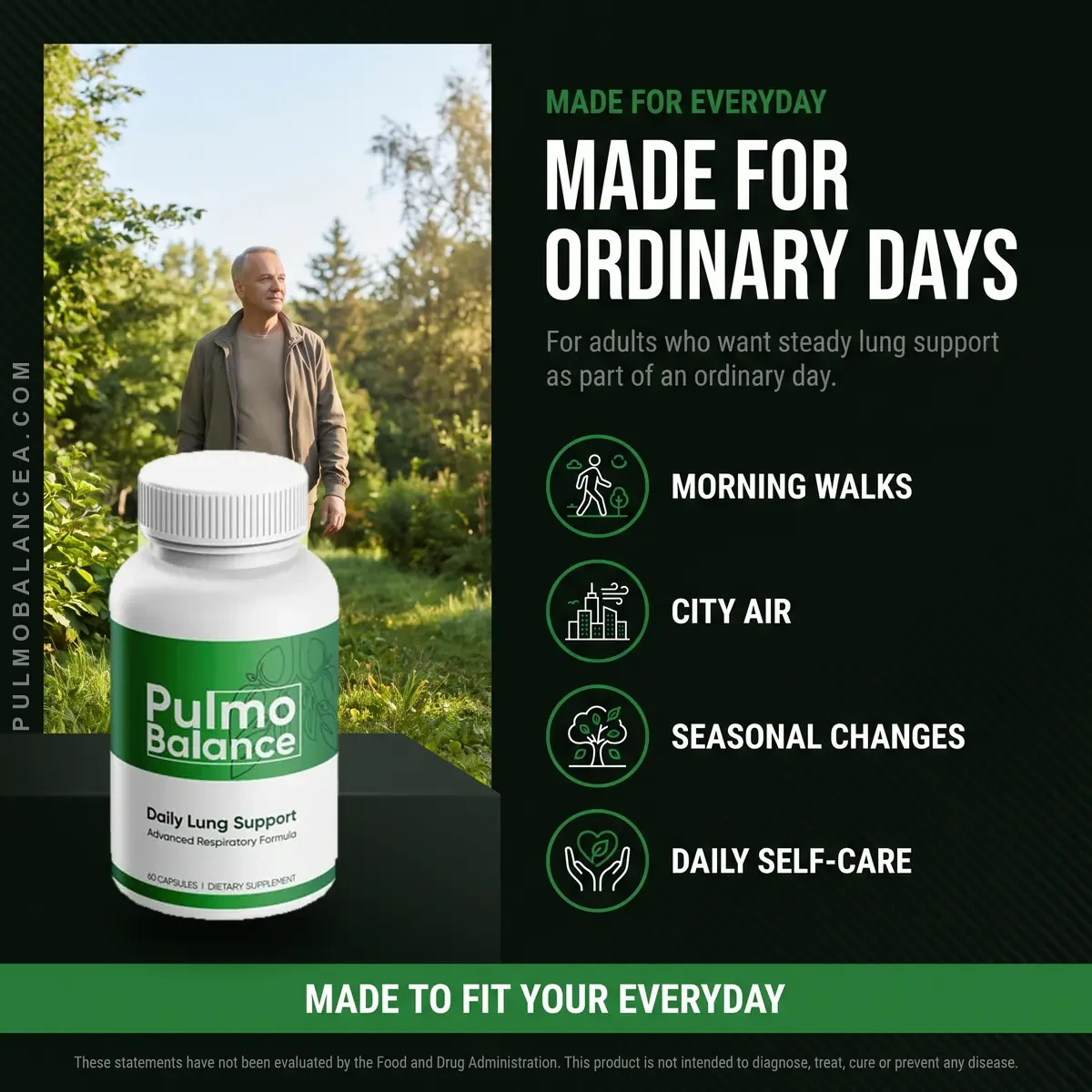
A lung supplement works at the opposite end of the same system: inside the body. Pulmo Balance, for example, is a once-daily capsule combining six respiratory botanicals — mullein, tiger milk mushroom, bromelain, maritime pine bark, stinging nettle and asparagus — in disclosed amounts. Rather than cleaning the air, it aims to provide everyday internal support: antioxidants for airway tissue that faces oxidative stress, soothing herbs, and traditional mucus support.
There is a nice conceptual overlap worth noticing. Because the air we breathe exposes airway tissue to constant oxidative stress — and an air purifier reduces some of that exposure at the source — the antioxidant angle of a supplement like maritime pine bark works on the same underlying issue from the inside. Our guide to the best herbs for lung health explains each botanical in detail. But a supplement’s limits are just as real as a purifier’s: it cannot remove a single particle from the air in your room, and it is general support, not a treatment for anything.
Lung supplement vs air purifier: side-by-side
| Where it works | Air purifier: the air around you. Supplement: inside your body. |
| What it does | Air purifier: removes airborne particles. Supplement: everyday internal botanical support. |
| Best for | Air purifier: poor indoor air — dust, smoke, pollen. Supplement: steady daily support alongside clean air. |
| Cost shape | Air purifier: bigger one-off + filters + power. Supplement: smaller recurring monthly cost. |
| Coverage | Air purifier: only the room it serves. Supplement: travels with you, taken anywhere. |
| Replaces the other? | No — they address different halves of the same problem. |
Laid out this way, the “versus” dissolves. The real question is not which one wins, but which gap in your own situation is bigger right now — the quality of the air you breathe, or the everyday support layer for your airways. For most people the honest sequence is: fix the air first, add the supplement second.
The internal support layer, in one daily capsule
Pulmo Balance handles the inside-the-body half — antioxidants from maritime pine bark and asparagus, soothing mullein, bromelain and nettle — in disclosed amounts, backed by a 60-day money-back guarantee. Pair it with clean air for a complete everyday approach.
See Pulmo Balance PackagesWhere the money is best spent
Because these are different kinds of purchase, the cost comparison is more useful than the “which is better” framing. An air purifier is a larger one-off outlay, plus recurring filter replacements and a small ongoing electricity cost. A supplement is a smaller, predictable monthly cost, and multi-bottle packs bring the per-bottle price down. Neither is expensive relative to the value of comfortable breathing, and they are not drawn from the same budget line in any meaningful sense.
If you are genuinely forced to choose one first, let your environment decide. If your indoor air is clearly compromised — you live with a smoker, near heavy traffic, in a dusty home, or through wildfire-smoke season — a purifier tackles the biggest lever first. If your air is already reasonable and you simply want a steady everyday support habit, a daily supplement is the affordable add-on. And if you want to understand what a supplement can realistically deliver before you buy, our honest look at whether lung supplements actually work sets expectations properly.
One stays home, the other travels with you
An air purifier only cleans the room it sits in. A daily capsule goes with you — to work, on trips, anywhere. A multi-bottle pack keeps that support uninterrupted at a lower per-bottle price, backed by the 60-day guarantee.
Compare Pulmo Balance PackagesThe honest tie-breaker: neither beats the fundamentals
Here is the part no product wants to lead with, but it is the truth. Whether you buy an air purifier, a supplement, both or neither, the biggest levers for lung health are free or nearly so: not smoking (and avoiding second-hand smoke), ventilating your home, keeping dust and mould down, moving your body regularly, and staying hydrated so mucus stays thin. An air purifier and a supplement are both useful support acts — the purifier improving the air, the capsule supporting the body — but they sit on top of those fundamentals, never in place of them. If you would rather compare a supplement to a free daily habit, our piece on a lung supplement versus breathing exercises makes the same “do both” case from a different angle.
So the answer to “lung supplement vs air purifier” is refreshingly un-dramatic: they are teammates, not rivals. Clean the air, support the body, and get the basics right — that combination beats any single purchase every time.
Which one has actually been tested in homes?
This is the comparison where the evidence is lopsided, and it is worth saying so. Air filtration has been studied in the place it is used: a longitudinal HEPA filter trial reported in the Journal of Environmental Science and Health, Part A (2026) looked at indoor environmental health and asthma relief in real homes, and the US EPA maintains practical, non-commercial guidance in Air Cleaners and Air Filters in the Home, including the important caveat that a filter cannot fix a source you have not removed.
Supplements have nothing equivalent. The closest respiratory-facing work on a botanical in this blend, maritime pine bark, is an animal airway-inflammation model in Food and Chemical Toxicology (2013), and NCCIH’s Using Dietary Supplements Wisely explains why that gap between mechanism and outcome matters. If you can only spend once and your air is genuinely bad, filtration is the more defensible purchase.
They are not really rivals, though; one reduces what you inhale and the other is a daily habit. A third option costs nothing at all, covered in lung supplement versus breathing exercises. If pollen is your trigger, the seasonal allergy guide is more specific, and the herbs guide covers what a capsule brings that a filter cannot.
See a doctor, not a supplement, for breathing that is getting worse. New, sudden or worsening breathlessness, a cough lasting more than three weeks, coughing up blood, chest pain, or a reliever inhaler that has stopped working can all signal asthma, COPD, infection or heart disease, and need assessing by a clinician. Seek emergency care for severe breathlessness, blue lips or chest pain. No dietary supplement treats, cures or prevents any lung condition.
Frequently asked questions
Lung supplement vs air purifier — what is the difference?
An air purifier is a device that cleans the air around you by filtering out particles such as dust, pollen and smoke before you breathe them in. A lung supplement is a daily botanical product taken internally to support your airways from the inside. One improves the air going in; the other supports the body receiving it. They work at completely different points in the same system.
Which is better for your lungs, a supplement or an air purifier?
Neither is a straight substitute for the other because they do different jobs. If your indoor air quality is poor — smoke, dust, pollen or pollution — an air purifier tackles the source. A daily supplement offers internal, everyday support. For most people the sensible answer is to improve the air first and use a supplement as an additional support layer, not to choose one over the other.
Can an air purifier replace a lung supplement?
No, and vice versa. An air purifier cannot supply antioxidants or botanicals to your body, and a supplement cannot remove pollutants from the air in your room. They address different halves of the problem, which is exactly why many people use both alongside the real fundamentals like not smoking and ventilation.
Do I still need clean air if I take a lung supplement?
Absolutely. Clean air is far more important than any supplement. No capsule can offset breathing heavily polluted or smoky air. A supplement is background support that sits on top of good air quality, ventilation and not smoking — never a reason to worry less about the air you breathe.
Is a lung supplement or an air purifier more cost-effective?
They are different kinds of spending. An air purifier is a larger one-off purchase with ongoing filter and running costs; a supplement is a smaller recurring monthly cost. Because they do different things, cost-effectiveness depends on your situation — poor indoor air makes a purifier the higher-value first step, while a supplement is an affordable ongoing support layer.
About the Pulmo Balance Research Team
The Pulmo Balance Research Team is an independent group of writers and reviewers focused on respiratory wellness. We compare popular options fairly — including devices such as air purifiers — and describe the traditional and general use of ingredients in plain English. Our guides are for information only and are not medical advice; please talk to your doctor before starting a supplement, especially if you have a respiratory condition or take medication.
References
- Indoor environmental health and asthma relief: findings from a longitudinal HEPA filter trial — J Environ Sci Health A, 2026. PMID 41979079.
- Air Cleaners and Air Filters in the Home — US EPA.
- Inhibitory effects of Pycnogenol (French maritime pine bark extract) on airway inflammation in ovalbumin-induced allergic asthma — Food Chem Toxicol, 2013. PMID 24120901.
- Using Dietary Supplements Wisely — NCCIH.
- Research on an ingredient is not evidence about a finished product. Every PubMed identifier above was re-checked against the NCBI record on 3 September 2026 and resolves to the paper named beside it.
† These statements have not been evaluated by the FDA. This product is not intended to diagnose, treat, cure or prevent any disease. This article is for general information only and is not medical advice.